A predictive decision tool that helps dealerships stock smarter by forecasting which vehicles are most likely to sell in the next 30 days. Market Demand Forecaster is a city-level predictive intelligence platform designed to help dealerships decide what inventory to stock each month. Instead of showing raw analytics, it synthesizes buyer intent signals, local economic conditions, and market dynamics into ranked, explainable forecasts — turning uncertainty into confident inventory decisions. By blending search momentum, price competitiveness, seasonality, fuel and interest-rate pressure, lease-replacement cycles, and local supply scarcity, the system predicts which vehicles are most likely to sell in the next 30 days — and explains why. Designed with an action-first UX philosophy, Market Demand Forecaster reframes analytics into decisions, helping sellers reduce inventory risk, improve sell-through speed, and adapt quickly to real-world market shifts.
Predictive Inventory Intelligence Platform
Product Design, UX Strategy, Data-Informed Design
Figma, AI product design, UX research, Marketplace analytics


Dealerships make high-risk inventory decisions with fragmented data.
They have:
• traffic reports
• listing metrics
• pricing dashboards
• market reports
But still struggle to answer the one question that matters:
What should I stock right now to sell faster and reduce risk?
When inventory decisions are wrong, vehicles stall on lots, discounts increase, and capital gets tied up.
Most revenue loss doesn’t come from poor sales execution —
it comes from misaligned inventory decisions.
Demand is driven by a blend of buyer intent, local economics, seasonality, and supply pressure — signals that sellers can’t realistically synthesize manually.
If marketplace demand signals and local economic indicators are unified into a ranked, explainable forecast, dealers can make faster, more confident inventory decisions and improve sell-through.
Market Demand Forecaster is a city-level forecasting system that:
• Predicts which vehicles are most likely to sell in the next 30 days
• Estimates relative time-to-sell and confidence
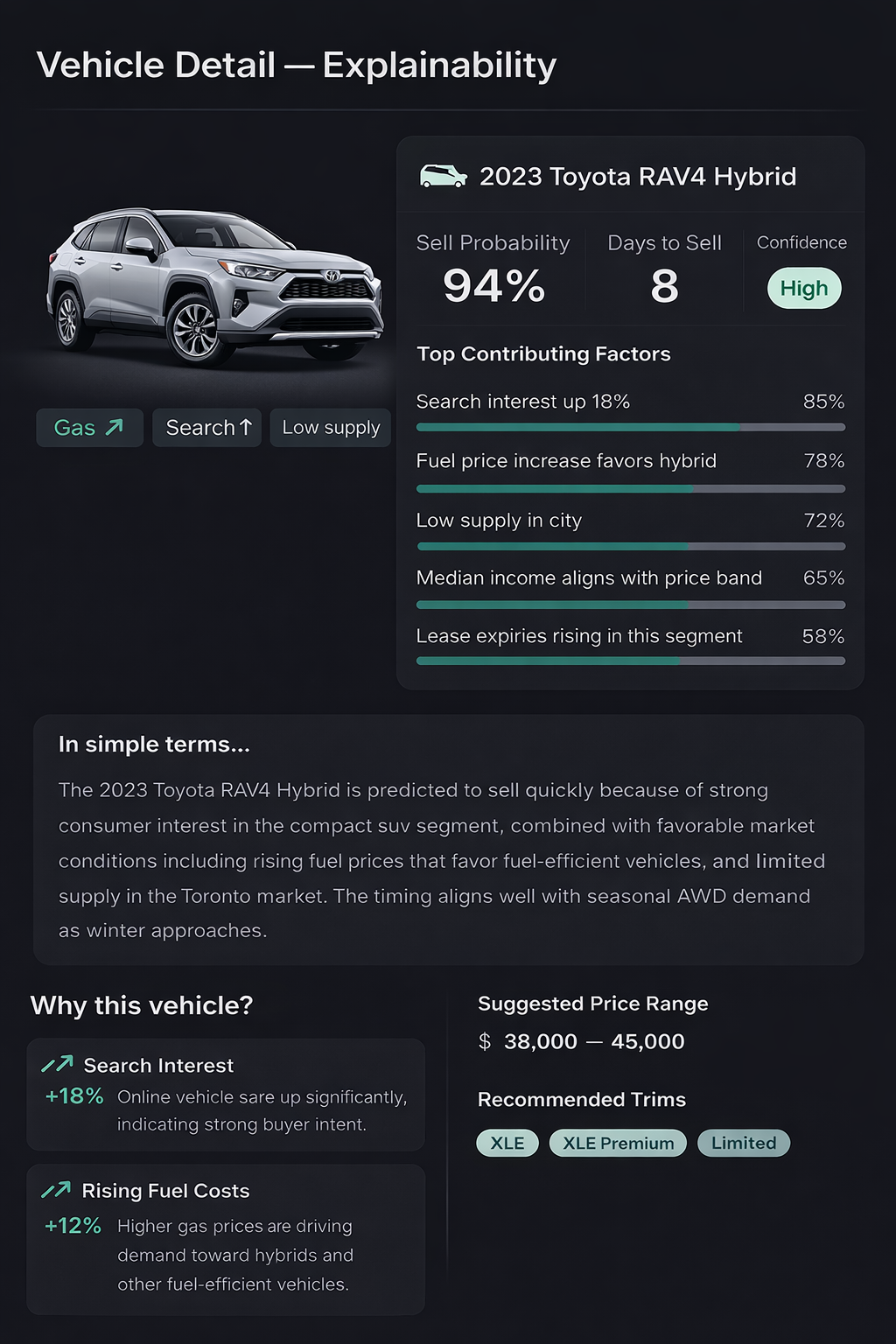
• Explains why each vehicle is trending
• Converts insight into inventory action plans
It reframes analytics into decisions.
Each vehicle is evaluated using a blend of real-world demand drivers:
Signal TypeWhy It MattersLocal search momentumReveals rising buyer interestLead & save activityIndicates purchase readinessPrice-to-market positionPredicts conversion likelihoodSeasonality & weatherShifts vehicle preferencesCity demographicsAligns vehicles to buyer realitiesLease expiry cyclesSignals replacement demandFuel & interest ratesAffect affordability & preferenceLocal supply levelsScarcity accelerates sell-through
These signals are synthesized using a gradient-boosted decision model to predict near-term demand and inventory risk.
To prevent forecasts from becoming stale, the system monitors real-world signals such as:
• Fuel price changes
• Interest rate shifts
• Seasonal transitions
• Supply disruptions
These live indicators dynamically adjust the forecast — keeping recommendations responsive to real market conditions.
This product was intentionally designed around:
• Explainability — every prediction shows why
• Confidence signaling — uncertainty is visible
• Human-in-the-loop control — dealers can override assumptions
• Action-first UX — insight always leads to next steps
• City Forecast Overview
• Vehicle Demand Detail
• Scenario Simulator
• Live Market Alerts
• Inventory Action Planner
• Trust & Methodology Panel
• Faster sell-through
• Reduced inventory risk
• Lower discounting pressure
• Higher confidence in inventory decisions
This project taught me how to design decision intelligence systems — products that don’t just present data, but actively reduce uncertainty in high-impact business decisions.